
For most of the last two decades, web hosting and Cloudflare grew together. Hosting companies provided the foundation—servers, databases, email, and WordPress installs—while Cloudflare sat on top as a performance and security layer.
That balance is now starting to break.
In 2026, Cloudflare is no longer just “a CDN you add to hosting.” It is increasingly becoming the default entry point for new websites, applications, and even domains. And that shift raises a difficult question for the hosting industry:
Is Cloudflare quietly replacing traditional web hosting rather than supporting it?
The Old Relationship: Hosting First, Cloudflare Second
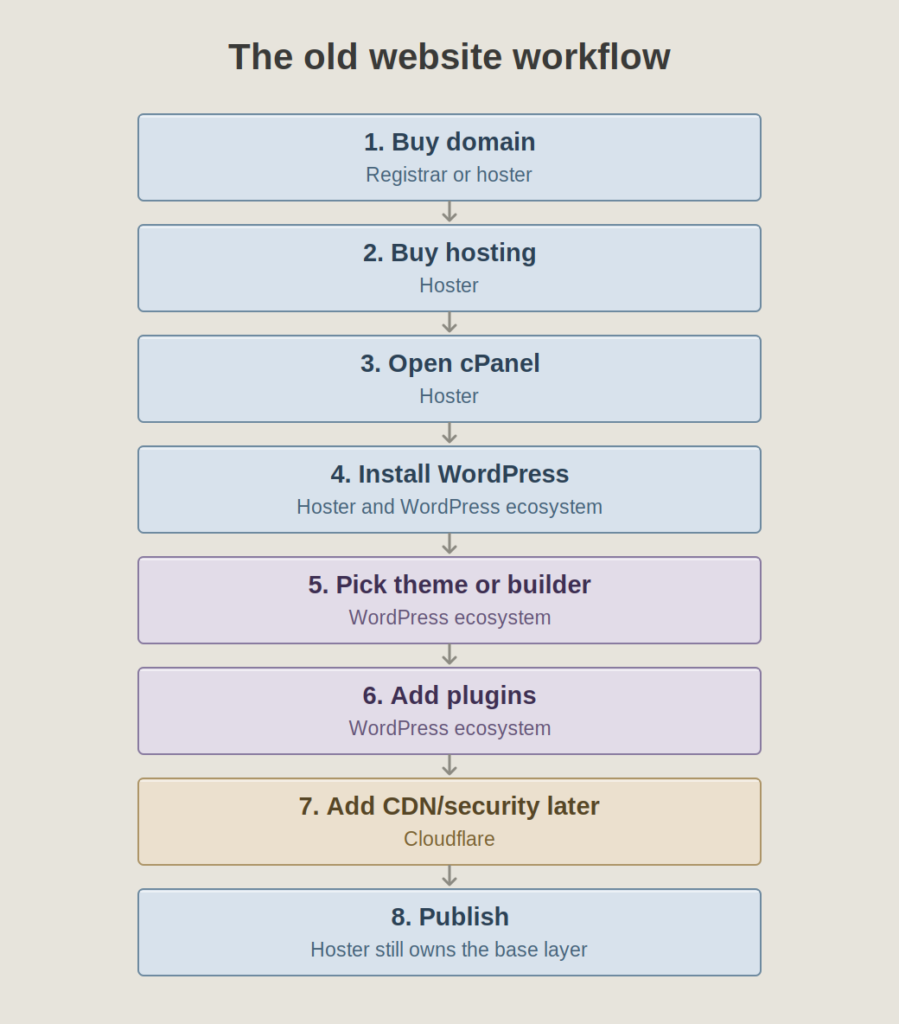
Historically, the workflow was simple and predictable:
- Buy a domain
- Buy shared hosting
- Install WordPress via cPanel
- Upload a theme
- Add plugins
- Configure SSL and email
- (Optional) connect Cloudflare for performance
In this model, hosting was the starting point. Everything else depended on it.
Cloudflare improved that ecosystem by adding:
- CDN acceleration
- DDoS protection
- Free SSL
- Caching and performance optimization
- Basic security filtering
But it still relied on traditional hosting underneath.
Even Cloudflare’s early growth reinforced that dependency. It integrated deeply with hosting stacks like cPanel, Plesk, and WHMCS, becoming part of the standard “hosting bundle.”
That phase is now over.
The Turning Point: Cloudflare Moves Beyond Hosting Integrations
A key structural change happened in 2022 when Cloudflare discontinued legacy Host and Reseller APIs. That marked a shift away from embedding itself inside shared hosting ecosystems.
Instead, Cloudflare moved in two new directions:
1. Enterprise Platform Layer
Cloudflare Enterprise became part of premium managed hosting stacks such as:
- WP Engine
- Kinsta
- Rocket.net
In this model, Cloudflare is not an add-on. It is part of the infrastructure itself.
2. Developer-First Platform
At the same time, Cloudflare doubled down on:
- Workers (serverless compute)
- Pages (static hosting)
- R2 (object storage)
- D1 (database layer)
- Registrar (domains)
This repositioned Cloudflare from “hosting enhancement tool” to “full application platform.”
The Real Shift: Websites No Longer Start with Hosting
The biggest disruption is not technical—it is behavioral.
The old question was:
“Which hosting plan do I need?”
The new question is:
“How do I deploy this project?”
This shift is driven heavily by AI-assisted development tools such as Cursor, Replit, v0, Bolt, and Lovable. These tools generate applications directly and push them toward deployment platforms—not traditional hosting panels.
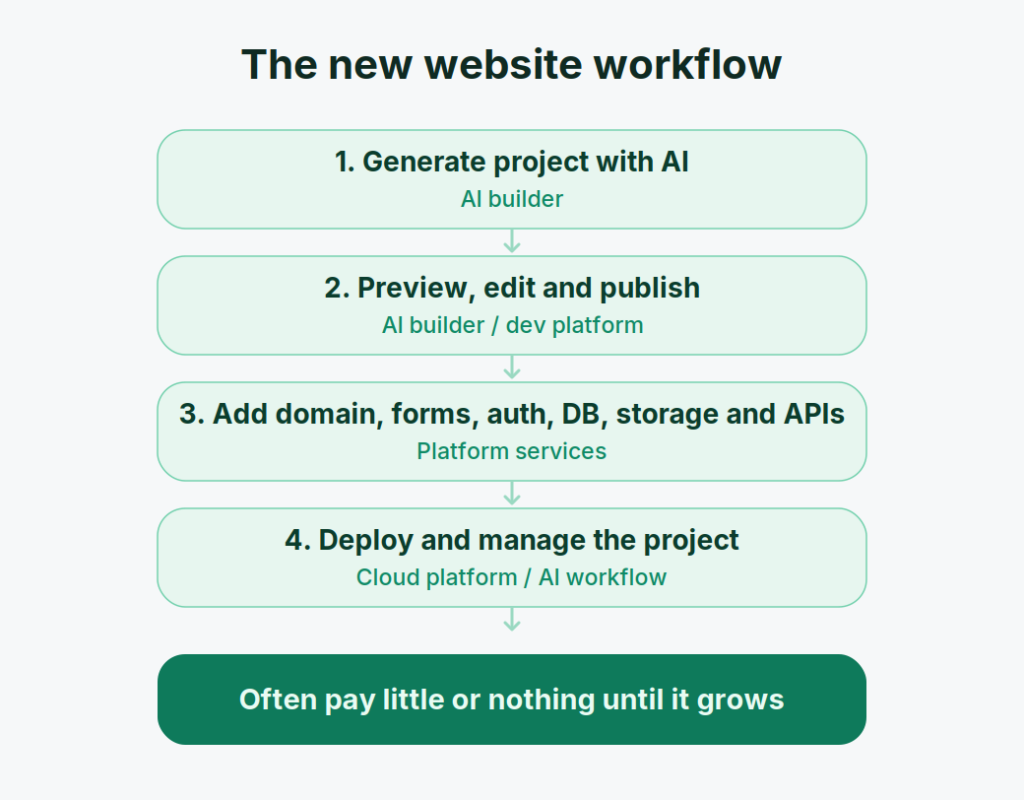
In practice, the starting point of a website has moved:
| Old Workflow | New Workflow |
|---|---|
| Buy hosting | Generate project |
| Install WordPress | Deploy to platform |
| Configure server | Connect domain via API |
| Upload files via FTP | Git / deploy button |
Cloudflare, alongside platforms like Vercel and Netlify, fits naturally into this new flow.
Traditional hosting often does not appear in it at all.
Cloudflare’s Core Advantage: It Removes the Hosting Decision
Cloudflare’s strategy is not just performance. It is abstraction.
With its platform, users can:
- Host static sites for free (Pages)
- Run backend logic (Workers)
- Store files (R2)
- Use databases (D1)
- Register domains (Registrar)
- Manage DNS and security
And in many cases, start at $0.
| Use case | Cloudflare product | Starting cost |
|---|---|---|
| Static website | Pages | $0 |
| Frontend app | Pages / Assets | $0 |
| Simple API | Workers | $0 |
| Scalable backend | Workers Paid | ~$5/month |
| Object storage | R2 | Free tier |
| Database | D1 | Free tier |
| Domain registration | Registrar | At-cost pricing |
This creates a powerful shift:
Hosting is no longer something you buy before launching a project.
It is something that appears automatically when you deploy.
The Domain Strategy: Cloudflare Attacks the Entry Point
Cloudflare is not only removing hosting friction—it is also attacking the domain layer.
Registrar pricing is extremely aggressive compared to traditional providers:
- .com: ~$10.46
- .net: ~$11.86
- .org: ~$10.13
By comparison, many legacy registrars charge significantly more.
But pricing alone is not the real disruption.
The bigger shift is integration.
With the introduction of the Registrar API (2026), domains are no longer a manual purchase step. They can now be:
- searched programmatically
- registered via API
- connected automatically to DNS
- deployed directly into applications
This enables a fully automated pipeline:
AI generates project → API registers domain → platform deploys site → DNS configured instantly
At that point, traditional hosting providers are removed from the funnel entirely.
Why Traditional Hosting Is Losing Control of the Funnel
Hosting companies historically owned the “starting point” of the web:
- Domain registration
- Hosting plan selection
- WordPress installation
- Email setup
- SSL configuration
That control created the customer relationship.
Cloudflare breaks that chain by removing the need for early commitment.
Now:
- Projects can be created without hosting decisions
- Deployment happens before infrastructure selection
- Domains and hosting are handled through APIs, not panels
The result is a structural loss of entry points for traditional hosting providers.
But Hosting Is Not Dead Yet (Far From It)
Despite this disruption, traditional hosting is not disappearing. It is shifting into a different role.
1. Legacy WordPress Ecosystem
Millions of sites still run on:
- PHP
- MySQL
- WordPress
- WooCommerce
These systems will not migrate overnight. They require:
- cPanel or similar control panels
- backups and restores
- plugin and theme management
- email hosting
Cloudflare does not replace this ecosystem.
2. Email Hosting Still Matters
Business email remains a critical dependency:
- invoices
- contracts
- internal communication
- compliance requirements
Most modern platforms avoid full email hosting responsibility. Traditional providers still dominate here.
3. Managed Support Is Still a Moat
When something breaks at 2 AM:
- hacked WordPress site
- broken plugin update
- DNS misconfiguration
- database failure
Companies still need humans, not dashboards.
This is where hosting providers still win.
4. Local Compliance and Regulation
Many businesses require:
- data residency guarantees
- local jurisdiction compliance
- regional support teams
- legal accountability
Cloudflare optimizes for global scale. Hosting providers can win locally.
So, Is Cloudflare Killing Hosting?
Not exactly.
A more accurate framing is this:
Cloudflare is not replacing hosting—it is removing the need to think about hosting for new projects.
That distinction is critical.
What Cloudflare is actually doing:
- Removing hosting from the early decision process
- Owning deployment workflows
- Controlling domains, DNS, compute, and storage
- Integrating into AI-driven development tools
- Reducing friction between idea → live product
What it is NOT replacing (yet):
- legacy WordPress ecosystems
- email infrastructure
- managed hosting services
- enterprise migration work
- compliance-heavy environments
Final View: The Industry Is Splitting in Two
The hosting market is no longer one unified layer.
It is splitting into two very different worlds:
1. Traditional Hosting World
- WordPress sites
- cPanel ecosystems
- email hosting
- managed support
- SMB infrastructure
2. Platform World (Cloudflare, Vercel, Netlify, etc.)
- AI-generated apps
- serverless deployments
- API-first infrastructure
- instant scaling
- zero-server workflows
Cloudflare is not “killing” hosting.
It is pulling new projects into a different universe where traditional hosting is no longer the default entry point.
And that is the real disruption.